Everything we are looking at.
A Prenuvo screening reads for more than 500 conditions across 78 organs. What follows is not a complete inventory — it is a guide to the questions patients ask us most when they ask, "what will this scan actually catch?"
The most useful result we deliver, most of the time, is the absence of a major finding.
The thing we want to say before the lists below: the most common outcome of a Prenuvo scan is no significant finding. For most patients, on most scans, the report comes back showing a body that looks broadly the way a body should look.
Wear and tear, sure.
Things to focus on to improve, absolutely.
Life-threatening findings, less likely.
That is the result that does not make headlines, and it is the result most worth paying for. The diffuse, low-grade worry that comes from never having looked — the question you carry around because you cannot answer it — converts into something definite: a clean structural baseline, against which next year’s scan can read change.
Most patients describe this as the most reassurance they have ever had about their own bodies.
When we do find something, we want to find it early enough that it is small, modifiable, or curable.
The rest of this page is about those things.

Early stage & chronic disease
How you are actually aging, in writing.
The other thing a Prenuvo scan does — arguably the thing it does most often — is identify chronic disease at a stage when the trajectory is still changeable. Most chronic diseases that shape healthspan and lifespan do not announce themselves with sudden symptoms. They develop quietly over years, sometimes decades, and the imaging signature is often visible long before a diagnosis would otherwise be made. Catching them early is the difference between "this is something I will manage" and "this is something I will regret not knowing."
Metabolic dysfunction-associated steatotic liver disease (MASLD, formerly called fatty liver disease) affects roughly a third of adults globally, and fewer than 5% of people who have it know that they do. A Prenuvo screening is a sensitive imaging tool for liver fat and our proprietary Body Composition Report can quantify liver fat levels. At a reversible stage, MASLD responds well to lifestyle change. At a later stage, it becomes cirrhosis and the available interventions narrow significantly.
Both kidneys are examined structurally on every scan. We can identify cortical thinning, cysts, scarring from prior infection, and the structural changes of early chronic kidney disease — findings often missed by serum creatinine alone in the early stages. CKD is a slow-moving condition, but it is one of the most consequential drivers of cardiovascular risk and mortality in middle and later life — and one of the most modifiable when caught early.
The bowel is one of the harder organ systems to image well, but a Prenuvo protocol can identify bowel-wall thickening, structural change, and the imaging signature of inflammatory bowel disease (Crohn’s, ulcerative colitis). For patients with vague GI symptoms that have not yet driven them to colonoscopy, the scan is often the thing that says: this is worth a closer look, soon.
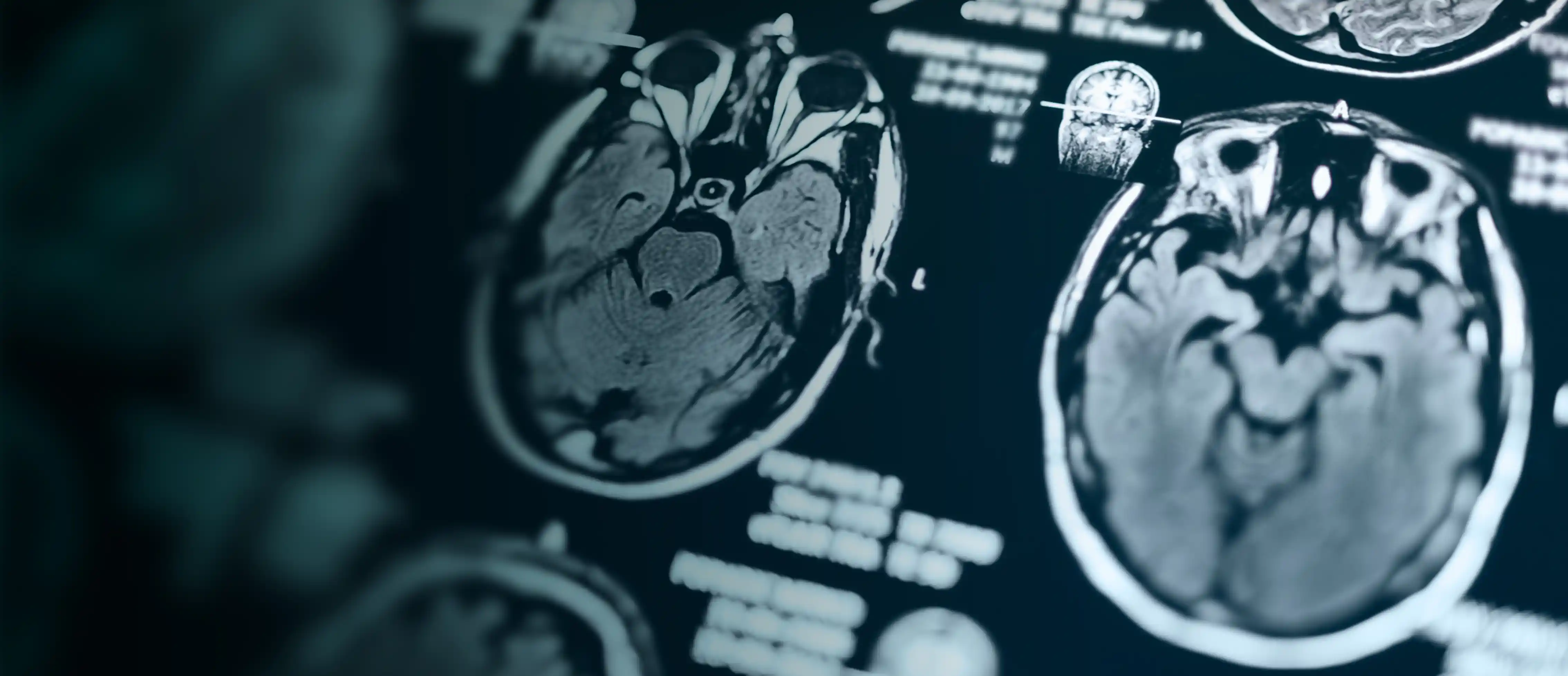
A brain scan is part of every Prenuvo visit. We are able to identify white matter integrity, and the signature of cerebral small vessel disease — markers increasingly linked in the literature to long-term cognitive trajectory. Some of our memberships include brain volume quantification by Neuroquant.For anyone with a family history of Alzheimer’s or Parkinson’s, year-over-year brain volume is one of the most actionable longitudinal readouts available outside a research setting — a quiet number that tells you, more precisely than anything else available, how your brain is actually aging.
Spine, hips, knees, shoulders. We see disc degeneration, early arthritis, labral tears, rotator-cuff change, and ligamentous injury — often before any of them have driven a patient to a physiatrist. For people who work hard at their fitness, the year-over-year MSK readout is a more honest picture of what your body is actually putting up with than the way you feel the morning after a good workout.
Thyroid nodules, adrenal incidentalomas, and body composition are all visible on every scan. In certain memberships we additionally include a Body Composition Report that quantifies this fat. Visceral fat in particular — the fat surrounding and infiltrating the organs, distinct from the subcutaneous fat under the skin — is one of the most quantitatively meaningful markers we measure. It is a strong imaging correlate of metabolic syndrome, type 2 diabetes risk, and cardiovascular risk, and a number that responds to lifestyle change in a way the bathroom scale does not.


I felt reassured knowing that I was thoroughly checked for any serious conditions, giving me peace of mind for the future.
Julie Buchman
Prenuvo patient
Case studies: women’s health
A standard of imaging women have rarely had access to.
Pelvic MRI is the gold-standard imaging modality for a number of conditions that profoundly affect women — and it is also one of the studies women are least likely to have had unless something has already gone wrong. A Prenuvo Comprehensive Scan includes a structural look at the female pelvis on every visit, for every patient. This is not the standard of care anywhere in the world. We think it should be.
Uterine anatomy
Prenuvo screening can sometimes identify uterine anomalies—such as septate, bicornuate, unicornuate, or didelphys uterus—that may interfere with fertility or increase the risk of miscarriage, preterm birth, or complications carrying a pregnancy to term. These congenital differences in uterine shape or structure are often undiagnosed until fertility challenges arise.
Endometriosis
Endometriosis affects roughly one in ten women of reproductive age, and the average time from symptom onset to diagnosis is between seven and ten years. Pelvic MRI is the most sensitive non-invasive imaging modality for deep infiltrating endometriosis. A Prenuvo scan can compress that diagnostic gap from a decade to a single afternoon.
Uterine fibroids and adenomyosis
Common, often asymptomatic, and frequently the cause of symptoms women have been told to consider normal. Both are visible, characterisable, and quantitatively measurable on MRI — which means they can be tracked year over year and acted on at the right moment.
Ovarian cysts and masses
Cysts, dermoids, suspicious lesions — all visible. The adjacency to the ovarian cancer discussion above is intentional: this is one of the few modalities that lets us watch ovaries year over year in an asymptomatic patient.
Pelvic floor and post-partum
A Prenuvo screening includes pelvic floor structures — useful for patients with post-partum or post-surgical symptoms that have not been adequately characterised by other studies, and rarely imaged at all in routine care.
Case studies: When you don’t feel right
For the times something feels wrong and the system has not told you what.
Persistent fatigue. A pain that moves. A sense that something is off but the labs have all come back normal. These are some of the hardest cases for the conventional medical system to resolve, because they do not fit the diagnostic flowchart of any single specialist. The standard path — a referral, a test, another referral, another test — often takes a year or more, and sometimes ends without an answer.
A Prenuvo screening is one of the few diagnostic tools that gives a structural look at every major organ system in a single sitting. It does not replace your physicians; it gives them a single, comprehensive starting point — a way to either find the thing, or to confidently rule out a long list of structural causes and move the workup forward.
Many of our patients in this category arrive having spent months or years not being heard. They tell us, after the scan, that it was the first time their concerns were taken at the size they had been carrying them.

Honest about what a whole-body scan does not do.
A Prenuvo scan is a broad structural survey of the body. It is excellent at what it does. It is not a replacement for every diagnostic modality nor is it a replacement for standard of care screening such as mammogram, colonoscopy or pap smear. A few examples of the questions for which another tool is the right tool:
Cardiac function
While a Prenuvo Advanced Heart Health Scan is a targeted assessment that evaluates heart health, our routine Comprehensive Scan is not a dedicated cardiac MRI for evaluating ejection fraction, valve function, or rhythm. Echocardiography, stress testing, and ECG remain the right tools for those questions.
Coronary artery disease
a coronary CT angiogram or a coronary calcium score is the right test for evaluating coronary plaque burden.
Mammographic micro-calcifications
we image breast structure on every scan, but mammography remains the standard for the very smallest calcifications, and a dedicated breast MRI has a different role from a Prenuvo screening. Many of our female members complement standard of care imaging with Prenuvo screenings.
Colonoscopic surveillance for small polyps
for patients who are due for a colonoscopy, get the colonoscopy. The scan is complementary, not substitutive.
Skin
visible to your physician, not to an MRI scanner.
Cellular and molecular diagnostics
we image structure, not biology at the cellular level.